

.png)
.png)
.png)
.png)
.png)
Find out how much
you're losing every
hour your systems
stay disconnected
Our team is ready to help you understand hidden costs
and savings opportunities for your organization.

Walk through almost any fulfillment or distribution center today and you'll see millions of dollars invested in automation. High-speed conveyors. Sophisticated sortation systems. Autonomous mobile robots. Vision systems. Automated storage. Artificial intelligence. The physical technology inside today's warehouses has evolved dramatically.
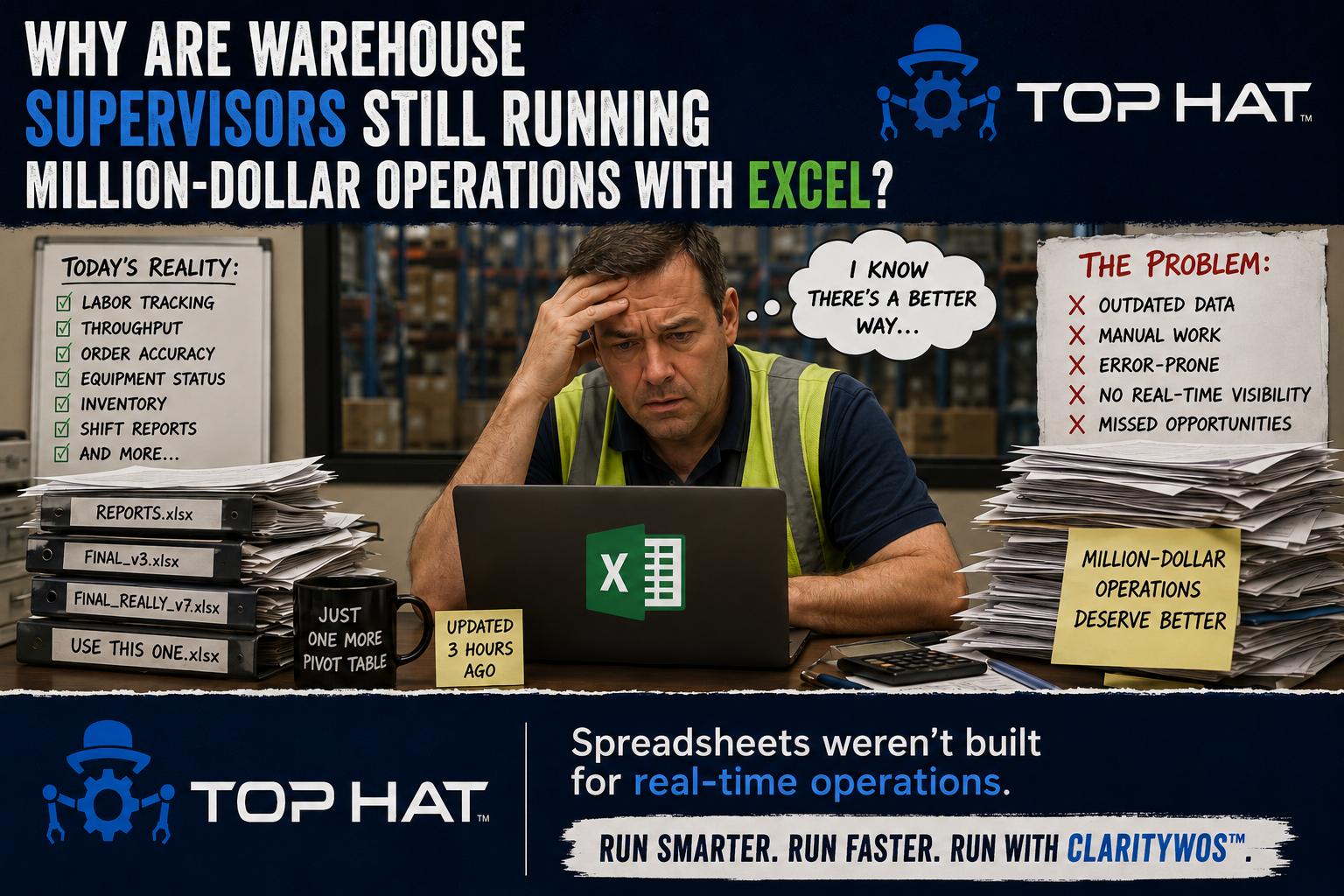
Yet if you walk into the warehouse supervisor's office, you'll often find the most important operational decisions being made in... Excel.
Think about that for a moment.
The individual responsible for determining which customer orders should be released first, how labor should be allocated throughout the day, which replenishment tasks are most critical, and whether customer pull-times will be met is frequently relying on manually maintained spreadsheets built from data extracted from multiple systems.
The irony is difficult to ignore.
Your local gym doesn't manage memberships with Excel. Your favorite restaurant doesn't manually calculate table turnover with spreadsheets. Even the coffee shop on the corner has software intelligently coordinating mobile orders, inventory, staffing, and customer pickups in real time.
Yet many companies generating hundreds of millions, or even billions of dollars in revenue still expect warehouse supervisors to manually correlate operational data across disparate systems just to determine what should happen next.
That isn't an employee problem.
It's a systems problem.
The Hidden Cost of "Spreadsheet Operations"
Ask a warehouse supervisor what their first hour of every shift looks like.
For many, it involves opening multiple applications and reports:
Only after manually assembling all of this information can they begin answering basic operational questions:
These aren't strategic decisions. They're operational decisions that need to happen continuously throughout the day. Yet we're still asking people to manually connect the dots.
The Warehouse Management System Was Never Designed to Orchestrate the Entire Operation
Warehouse Management Systems have become exceptionally good at managing inventory accuracy, executing transactions, directing work, and maintaining inventory integrity. They do exactly what they were designed to do. The challenge is that warehouse operations have evolved faster than traditional WMS platforms. Today's fulfillment environments require thousands of decisions every hour that extend well beyond inventory transactions.
A WMS knows where inventory is.
A Labor Management System knows where employees are.
A Warehouse Control System knows what automation is doing.
Transportation systems know departure times.
Business intelligence tools measure KPIs.
Each system performs its own function exceptionally well.
The problem is that none of them are responsible for continuously correlating all that information to determine what the operation should do next. That responsibility has quietly fallen onto the warehouse supervisor, and Excel became the glue holding everything together.
We've Accidentally Made People the Integration Layer
When supervisors spend their day exporting reports, comparing spreadsheets, checking dashboards, and manually reprioritizing work, they aren't supervising operations.
They're acting as middleware between software platforms.
Every manual spreadsheet introduces:
Perhaps most importantly, it creates operational knowledge that exists inside people's heads instead of inside the software running the facility. If one experienced supervisor takes a vacation, or resigns, the operation suddenly loses years of decision-making expertise. That should concern every operations executive.
The Next Evolution Isn't More Automation…It's Better Orchestration
For years, our industry has focused on automating physical work.
Conveyors reduced walking.
Sortation reduced manual handling.
Robots reduced transportation.
Vision systems reduced inspection.
The next competitive advantage won't come from simply adding more automation. It will come from orchestrating everything already inside the building.
Operations need software capable of continuously evaluating labor, inventory, order priorities, equipment status, transportation schedules, replenishment requirements, automation capacity, and operational KPIs simultaneously then recommending or executing the best operational decisions in real time.
Instead of asking supervisors to interpret data, the software should interpret it for them.
Instead of manually deciding what wave to release next, the system should know and just do it.
Instead of reacting after a pull-time is missed, the system should proactively inform the operations team and recommend staffing adjustments.
Instead of relying on spreadsheets to identify labor shortages, software should recognize them instantly and recommend adjustments before performance declines.
The supervisor's role should shift from gathering information to leading people and continuously improving the operation.
It's Time to Retire Excel as an Operational Control System
Excel has been one of the most valuable business tools ever created. It remains indispensable for analysis, planning, budgeting, and reporting. But it should never be the system responsible for running live warehouse operations.
If your supervisors still begin every shift by exporting reports from multiple applications and manually piecing together operational decisions, your warehouse isn't truly operating from a single source of intelligence. It's operating from a collection of disconnected systems held together by spreadsheets and experience.
The industry has reached an inflection point.
Warehouse orchestration represents the next evolution of operational software—not because it replaces the systems organizations already own, but because it enables them to work together as a coordinated operation. When decisions become automated instead of manually assembled, organizations gain faster response times, improved labor utilization, better inventory flow, higher throughput, fewer missed pull-times, more consistent execution across shifts, and greater resilience as experienced personnel retire or move on.
For years we've invested in automating the movement of products.
Now it's time to automate the movement of decisions.


Our team is ready to help you understand hidden costs
and savings opportunities for your organization.

An optimized warehouse starts with automation.
Talk to our team today to turn your warehouse into an intelligent one.